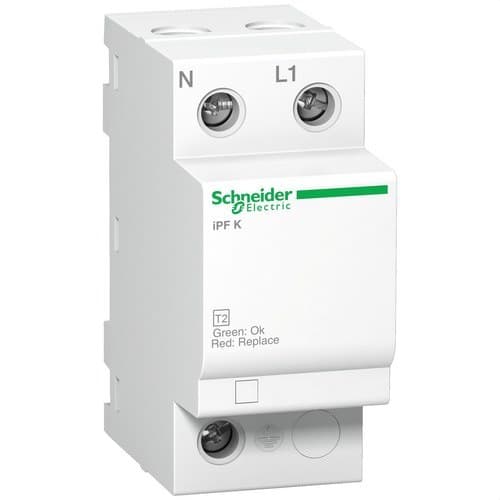
Information about Type 2 Surge Protection Device Acti9 iPFK40 40KA 340V 1P+N
The Schneider Electric Acti9 iPF K A9L15687 surge protection device is a Type 2 SPD in 1P+N configuration, designed to protect electrical installations and connected equipment against transient overvoltages caused by atmospheric phenomena or switching operations on the network. It offers a maximum discharge current Imax of 40 kA, a nominal discharge current In of 15 kA, and a maximum protection level Up below 1.5 kV. It is intended for single-phase 230 V AC networks with TT and TN-S earthing systems.
Reference A9L15687 belongs to Schneider Electric's Acti9 iPF K range and combines MOV + GDT technologies to provide protection between phase, neutral and earth. Its 2-module monobloc design, DIN rail mounting, optical status indicator and compact dimensions make it easy to integrate into residential, commercial and tertiary electrical panels.
Type 2 surge protection device
The Schneider Electric A9L15687 is classified as a Type 2 surge protection device in accordance with IEC 61643-11.
Type 2 SPDs are intended to limit transient overvoltages reaching an electrical installation and reduce their amplitude before they can affect connected equipment.
Schneider Electric specifies this device for secondary protection of loads and for cascade installation with other protectors located upstream when the surge protection design requires it.
1P+N configuration for single-phase networks
The Acti9 iPF K A9L15687 features a 1P+N configuration, suitable for single-phase networks with phase and neutral.
- Configuration: 1P+N.
- Rated operating voltage Ue: 230 V AC ±10%.
- Frequency: 50/60 Hz.
- Earthing systems: TT and TN-S.
The choice of network system is essential in a surge protector, as it determines how the protection elements between phase, neutral and earth are connected and coordinated.
Maximum discharge current Imax of 40 kA
The 40 kA value included in the commercial designation corresponds to the maximum discharge current Imax with an 8/20 µs waveform.
Schneider Electric specifies:
- Imax L-PE: 40 kA.
- Imax N-PE: 40 kA.
- Imax L-N: 40 kA.
This value represents the maximum impulse current the device can discharge under the test conditions established for a Type 2 SPD.
Nominal discharge current In of 15 kA
The nominal discharge current In is 15 kA with an 8/20 µs waveform.
- In L-PE: 15 kA.
- In N-PE: 15 kA.
- In L-N: 15 kA.
Therefore, it is important to distinguish the two main values:
- In = 15 kA: nominal discharge current.
- Imax = 40 kA: maximum discharge current.
The 40 kA in the product name should not be interpreted as the nominal current In.
Uc of 340 V between phase and neutral
The maximum continuous operating voltage Uc also depends on the connection mode:
- Uc between phase and neutral L-N: 340 V AC.
- Uc between neutral and earth N-PE: 260 V AC.
Therefore, the commercial indication of 340 V refers specifically to the maximum continuous voltage between phase and neutral.
Protection level Up below 1.5 kV
The voltage protection level Up determines the maximum residual voltage appearing across the SPD during standardized discharge conditions.
For the A9L15687, Schneider Electric specifies:
- Up L-N: below 1.5 kV.
- Up N-PE: below 1.5 kV.
The lower this value is compared with the withstand voltage of the protected equipment, the greater the margin available to limit surges reaching the loads.
MOV + GDT technology
The Acti9 iPF K surge protector uses a combination of technologies:
- MOV: metal oxide varistor.
- GDT: gas discharge tube.
This architecture makes it possible to adapt protection to the 1P+N configuration and to the TT and TN-S earthing systems covered by Schneider Electric.
Protection for TT and TN-S networks
Reference A9L15687 is specifically intended for networks with the following earthing systems:
- TT.
- TN-S.
Schneider Electric highlights its suitability for installations with high prospective short-circuit currents, provided it is combined with the appropriate overcurrent protection device.
Short-circuit rating Isccr of 25 kA
The technical data sheet specifies a rated short-circuit current Isccr of 25 kA for the SPD under the coordination conditions indicated by Schneider Electric.
The surge protector must not be confused with a circuit breaker: the A9L15687 does not itself include thermal-magnetic protection against overloads and short circuits.
Recommended backup protection
Schneider Electric specifies the following associated devices:
- iK60N circuit breaker: 40 A, C curve, Icu 6 kA.
- gG fuse: 63 A, Icu 25 kA.
The final choice of backup device must be made according to the available short-circuit current, the installation and the coordination rules established by Schneider Electric.
Protection against temporary overvoltages
In addition to impulse tests, Schneider Electric specifies resistance values against certain temporary overvoltages Ut:
- 337 V L-N: withstand for 5 seconds.
- 442 V L-PE: withstand for 5 seconds.
- 1,200 V N-PE: withstand for 200 ms.
- 1,453 V L-PE: withstand for 200 ms.
These values are part of the device's standardized performance and should not be interpreted as permissible permanent operating voltages.
Response time of 25 ns or less
The Acti9 iPF K A9L15687 has a response time ≤25 ns, allowing it to react quickly to transient voltage surges.
The effectiveness of the final protection also depends on correct SPD installation, cable length and layout, and coordination with other protectors in the system.
Optical status indicator
The device incorporates a local visual indication that allows the operating status of the protector to be checked during panel inspections.
This reference does not include a remote signaling contact, so its status is monitored locally on the device itself.
DIN rail mounting
The A9L15687 is designed for clip-on mounting on a DIN rail.
- Width: 36 mm.
- Height: 81 mm.
- Depth: 69 mm.
- Modular width: 2 modules of 18 mm.
- 9 mm pitches: 4.
- Net weight: approximately 210 g.
- Color: white RAL 9003.
Its two-module format makes it easy to incorporate into distribution boards where available space is limited.
Terminals for conductors up to 25 mm²
The protector uses tunnel terminals located at the top or bottom.
- Rigid conductor: up to 25 mm².
- Flexible conductor: up to 16 mm².
- Flexible conductor with ferrule: up to 16 mm².
- Strip length: 11 mm.
- Tightening torque: 3.5 Nm.
In surge protectors, it is especially important to keep connections as short and direct as possible in accordance with installation instructions, as conductor inductance can increase the residual voltage reaching the equipment.
Degree of protection
Schneider Electric specifies:
- Front part: IP40 in accordance with IEC 60529.
- Terminals: IP20 in accordance with IEC 60529.
- Impact resistance: IK03 in accordance with IEC 62262.
The device must be installed inside a suitable enclosure or panel to achieve the protection degree required by the installation.
Environmental operating conditions
- Operating temperature: -25 to 60 °C.
- Storage temperature: -40 to 85 °C.
- Relative humidity: 5-95%.
- Operating altitude: up to 2,000 m.
Applications of the Schneider Electric A9L15687
The Acti9 iPF K 40 can be used as part of surge protection for single-phase installations compatible with its electrical characteristics.
Possible applications include:
- Residential electrical panels.
- Homes.
- Commercial premises.
- Office buildings.
- Tertiary installations.
- Secondary distribution boards.
- Sensitive electronic equipment.
- HVAC systems.
- Control and automation equipment.
- Installations in TT or TN-S networks.
Cascade protection
Schneider Electric indicates that this SPD can be used to provide secondary protection of loads and installed in cascade with surge protectors located at the installation entrance.
A cascade architecture makes it possible to coordinate different protection levels to progressively reduce the surge before it reaches the most sensitive equipment.
Technical characteristics of the Schneider Electric A9L15687
- Brand: Schneider Electric.
- Reference: A9L15687.
- Range: Acti9.
- Family: Acti9 iPF K.
- Short name: iPF K 40.
- Type: transient surge protection device SPD.
- Class: Type 2.
- Application: electrical distribution.
- Configuration: 1P+N.
- Compatible networks: TT and TN-S.
- Technology: MOV + GDT.
- Rated voltage Ue: 230 V AC ±10%.
- Frequency: 50/60 Hz.
- Nominal discharge current In: 15 kA.
- Maximum discharge current Imax: 40 kA.
- Uc L-N: 340 V AC.
- Uc N-PE: 260 V AC.
- Up L-N: <1.5 kV.
- Up N-PE: <1.5 kV.
- Isccr: 25 kA.
- Response time: ≤25 ns.
- Earth leakage current Ipe: 0.003 mA.
- Local signaling: optical.
- Remote signaling: no.
- Associated circuit breaker indicated: iK60N 40 A C curve, Icu 6 kA.
- Associated fuse indicated: gG 63 A, Icu 25 kA.
- Mounting: clip-on DIN rail.
- Width: 36 mm.
- Height: 81 mm.
- Depth: 69 mm.
- Modular width: 2 modules.
- Weight: approximately 210 g.
- Color: white RAL 9003.
- Maximum rigid conductor: 25 mm².
- Maximum flexible conductor: 16 mm².
- Strip length: 11 mm.
- Tightening torque: 3.5 Nm.
- Front protection: IP40.
- Terminal protection: IP20.
- Impact resistance: IK03.
- Operating temperature: -25 to 60 °C.
- Storage temperature: -40 to 85 °C.
- Operating altitude: up to 2,000 m.
- Standard: IEC 61643-11:2011.
- Certifications: CE and EAC.
- EAN: 3606480089831.
40 kA Type 2 protection for TT and TN-S networks
The Schneider Electric Acti9 iPF K A9L15687 combines in just two modules a Type 2 protection with Imax of 40 kA, In of 15 kA and Up below 1.5 kV. Its 1P+N configuration and MOV + GDT technology are specifically adapted to single-phase installations with TT and TN-S networks.
The optical indicator allows visual status checking, while the Isccr capacity of 25 kA and the coordination options with circuit breaker or fuse facilitate integration into properly designed distribution boards.
Important: the A9L15687 protects against transient overvoltages, but does not replace a thermal-magnetic circuit breaker, an RCD, or protection against permanent overvoltages when required. To obtain the intended performance, the network system, backup protection, conductor cross-sections, earthing, and maximum connection lengths indicated by Schneider Electric must be respected.
