Schneider Electric HMI Touchscreen 5.7" TFT LCD Colour COM1 USB 2.0
Information about Schneider Electric HMI Touchscreen 5.7" TFT LCD Colour COM1 USB 2.0
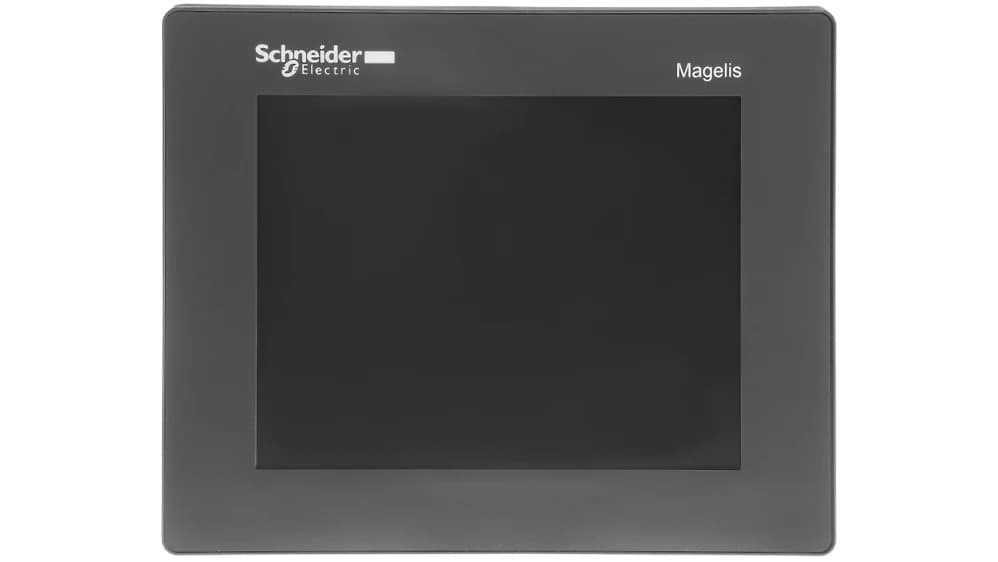
The Schneider Electric Harmony STU HMISTU855 HMI touchscreen is a 5.7-inch human-machine interface designed to visualize, monitor, and control automation processes and machinery. It features a color TFT LCD QVGA display with 320 x 240 pixels and 65,536 colors, an analog touch panel, 24 V DC power supply, and comprehensive communication options via COM1 RS232C/RS485, Ethernet TCP/IP, and two USB 2.0 ports.
The Harmony STU HMISTU855 is especially suited for machine builders, automation panels, and industrial installations that need a compact interface to display synoptics, variables, alarms, trends, buttons, and process statuses. Its innovative mounting system using a single 22 mm hole greatly simplifies installation on doors and panels, avoiding the large rectangular cutout commonly required by many HMI screens.
5.7-inch color TFT LCD display
The main element of the HMISTU855 is its 5.7-inch color TFT touchscreen, suitable for clearly and accessibly representing machine and process information for the operator.
- Screen size: 5.7 inches.
- Technology: color TFT LCD.
- Resolution: 320 x 240 pixels.
- Format: QVGA.
- Number of colors: 65,536.
- Touch technology: analog.
- Brightness levels: 16.
- Backlight life: approximately 50,000 hours.
The combination of graphical display and touch surface makes it possible to replace numerous physical pushbuttons, pilot lights, selectors, and indicators with virtual elements configurable in the HMI application.
Touch interface for monitoring and control
The screen allows the development of graphical pages from which the operator can view information and send commands to the automation system.
Elements that can be included in applications include:
- Numeric and alphanumeric values.
- Touch buttons.
- Virtual pilot lights.
- Bar graphs.
- Indicators and gauges.
- Trend curves.
- Alarms.
- Recipes.
- Images and bitmaps.
- Machine statuses.
- Process variables.
This makes it possible to create an interface adapted to each machine or process and centralize different operating functions in a single terminal.
COM1 RS232C / RS485 port
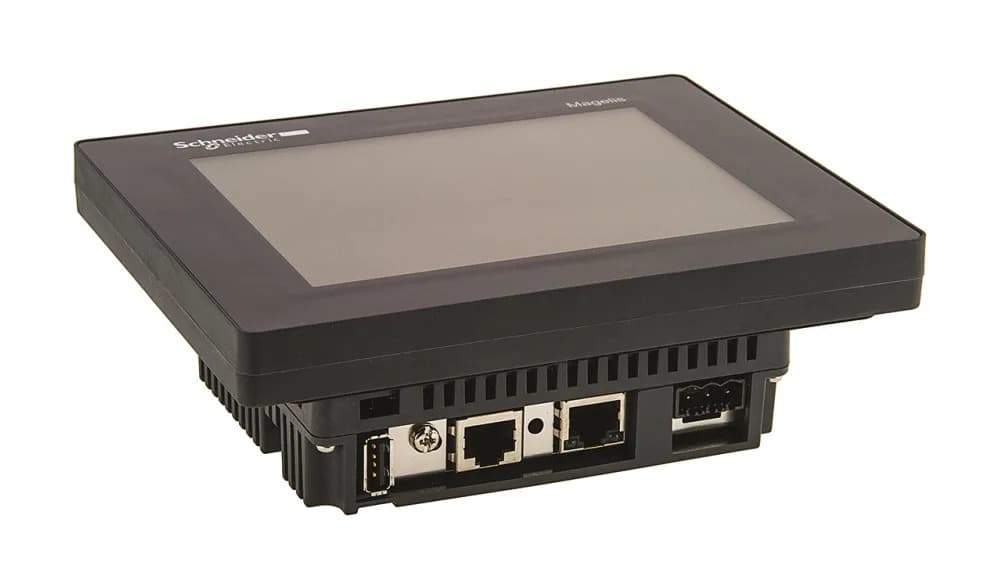
The Schneider Electric HMISTU855 incorporates a COM1 serial port with RJ45 connector, configurable for communication:
- RS232C.
- RS485.
This interface makes it easy to connect directly to PLCs, controllers, drives, and other compatible automation devices.
The presence of RS485 is especially useful for industrial networks and Modbus communications, while RS232C allows connection to certain devices that use point-to-point serial communication.
Integrated Ethernet TCP/IP
In addition to serial communication, the HMISTU855 includes a 10BASE-T/100BASE-TX Ethernet RJ45 port.
This connection allows the HMI to be integrated into industrial Ethernet architectures and to communicate with controllers and other compatible equipment using protocols supported by the software and device.
Communication possibilities for the family include:
- Modbus.
- Modbus TCP/IP.
- Uni-TE.
- Protocols for Schneider Electric equipment.
- Protocols for certain third-party PLCs.
Schneider Electric includes controllers from manufacturers such as Allen-Bradley, Mitsubishi Electric, Omron, and Siemens among the protocols available for the platform, depending on the equipment, protocol, and configuration used.
Two USB 2.0 connections
The Harmony STU HMISTU855 features 2 USB 2.0 interfaces with different functions.
USB 2.0 Type A Host
The USB Type A port allows connection of compatible peripheral devices and USB flash drives.
It can be used for functions such as:
- Connecting a USB flash drive.
- Transferring applications.
- Exchanging certain data.
- Connecting compatible peripherals.
USB 2.0 Mini-B Device
The second port uses a USB Mini-B connector and is mainly intended for application transfer and communication with a programming computer.
This dual interface simplifies commissioning, maintenance, and project update operations.
24 V DC power supply
The HMI is powered by an external direct current supply.
- Rated voltage: 24 V DC.
- Supply range: 20.4-28.8 V DC.
- Consumption: approximately 6.8 W.
- Inrush current: up to 30 A during the corresponding transient.
Power connection is made via a removable screw terminal block, making wiring and replacement or maintenance tasks easier.
333 MHz ARM9 processor
The Schneider Electric HMISTU855 uses an architecture based on an ARM9 CPU with a processor frequency of approximately 333 MHz.
It is specifically designed to run compact HMI applications, manage industrial communications, and update the graphical pages used to monitor the machine.
Vijeo Designer software
Harmony STU screens are configured using Schneider Electric's Vijeo Designer software.
This environment allows the development of the different operating pages and the association of graphical objects with PLC or controller variables.
HMI application possibilities include:
- Design of operator screens.
- Viewing and modifying variables.
- Alarm management.
- Histories and logs.
- Trend curves.
- Recipes.
- Virtual buttons and selectors.
- Communication setup.
The required version of Vijeo Designer may vary depending on the generation and hardware version of the rear module installed. For maintenance of existing installations, it is recommended to check the label and version of the module before selecting the software.
Modular architecture with display and rear module
A particular feature of Harmony STU is its construction in two modules:
- Front module: contains the touchscreen.
- Rear module: integrates CPU, power supply, and communication connections.
In HMISTU855 units manufactured according to the architecture after March 2012, Schneider Electric indicates that the commercial assembly is composed of:
- HMIS85: 5.7-inch color TFT display module.
- HMIS5T: rear module with processor and connections.
This architecture facilitates certain maintenance tasks and allows the display to be physically separated from the rear electronics.
Memory for HMI applications
The memory specifications of the HMISTU855 may vary depending on the generation of the rear module. The current Harmony STU catalog specifies 32 MB of application memory for the HMISTU855 configuration based on the HMIS5T module.
Schneider Electric also documents older first-generation units with lower capacity. Therefore, when maintaining or replacing equipment installed years ago, the rear module label and manufacturing date should be checked.
Installation through a single 22 mm hole
One of the most interesting features of the Harmony STU range is its mounting system using a 22 mm circular hole, similar to that used for industrial pushbuttons.
This solution avoids the need to make the usual large rectangular cutout used by many HMI terminals.
The system can provide several advantages:
- Reduced machining work.
- Faster installation.
- Smaller cutout area on the panel door.
- Easy mounting on machinery.
- Simple separation between front and rear modules.
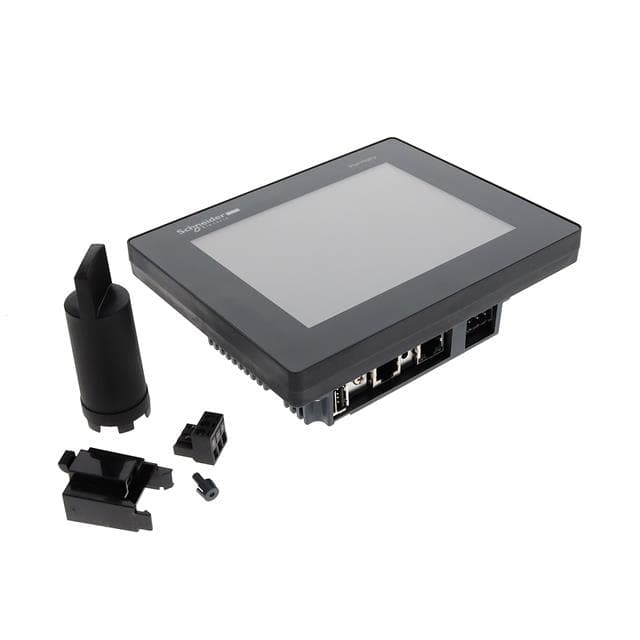
The fastening system includes a nut and gasket, and may use an optional anti-rotation element.
IP65 front protection
Once correctly installed according to Schneider Electric instructions, the screen provides:
- Front side: IP65 according to IEC 60529.
- Rear side: IP20 according to IEC 60529.
- NEMA front protection: NEMA 4X for indoor use.
The IP65 front protection is especially suitable for mounting on panel doors and consoles where the outer surface may be exposed to dust or splashes.
IP65 protection refers to the correctly installed front; the rear module still requires a suitable enclosure.
Schneider Electric HMISTU855 dimensions
- Width: 163 mm.
- Height: 129.15 mm.
- Depth: 56.5 mm.
- Screen size: 5.7 inches.
- Mounting hole: Ø 22 mm.
The fastening system makes it possible to have a relatively large viewing area without requiring major machining of the panel door.
Industrial-use enclosure
Schneider Electric specifies enclosure materials based on PC/PBT and PAA, selected for the usual conditions of industrial operator interfaces.
The screen includes the Schneider Electric logo on the front and carries CE marking, as well as different industrial certifications depending on the market.
Temperature and environmental conditions
The terminal is designed to operate within the following environmental limits:
- Operating temperature: 0 to 50 °C.
- Storage temperature: -20 to 60 °C.
- Relative humidity: 0-85%, non-condensing.
- Shock resistance: 15 gn for 11 ms according to IEC 60068-2-27.
- Resistance to electromagnetic fields: 10 V/m according to IEC 61000-4-3.
These features are intended for integration into panels and machinery in controlled industrial environments.
Communication with PLCs and automation equipment
The HMISTU855 is designed to work as an interface between the operator and the machine control system.
It can communicate with automation equipment via:
- RS232C.
- RS485.
- Ethernet TCP/IP.
- Modbus.
- Modbus TCP/IP.
- Uni-TE.
- Compatible third-party protocols.
This allows the screen to be integrated into new or existing installations using different automation architectures.
HMISTU855 HMI screen applications
The Schneider Electric Harmony STU HMISTU855 is especially suitable for monitoring and operating machines and small automated processes.
Typical applications include:
- Compact industrial machinery.
- Automation panels.
- Conveyor and transport systems.
- Handling systems.
- Packaging machines.
- Food industry.
- Pharmaceutical industry equipment.
- Pumps and hydraulic systems.
- Industrial ventilation and HVAC.
- Process equipment.
- OEM machines.
- Infrastructure.
Alarm, trend, and recipe visualization
The Harmony STU platform allows the development of applications that go beyond a simple pushbutton panel.
Functions supported by the range include:
- Alarm logging and display.
- Trend display with logging.
- 32 groups of up to 64 recipes.
- Variable representation using text and graphics.
- Buttons, pilot lights, bars, and indicators.
These functions make it possible to present the operator with relevant machine operating information in a structured and understandable way.
Technical characteristics of the Schneider Electric HMISTU855
- Brand: Schneider Electric.
- Reference: HMISTU855.
- Range: Harmony.
- Family: Harmony STO & STU.
- Series: Harmony STU.
- Type: HMI touchscreen.
- Application: machine visualization, monitoring, and control.
- Screen size: 5.7 inches.
- Display technology: color TFT LCD.
- Resolution: 320 x 240 pixels QVGA.
- Colors: 65,536.
- Touch panel: analog.
- Brightness: 16 levels.
- Backlight life: approximately 50,000 hours.
- Processor: ARM9.
- Processor frequency: 333 MHz.
- Application memory: up to 32 MB in current configurations with HMIS5T module; check hardware version.
- Power supply: 24 V DC.
- Supply range: 20.4-28.8 V DC.
- Consumption: approximately 6.8 W.
- COM1 port: RS232C / RS485 via RJ45.
- Ethernet: 10BASE-T / 100BASE-TX via RJ45.
- USB Host: 1 x USB 2.0 Type A.
- USB Device: 1 x USB 2.0 Mini-B.
- Protocols: Modbus, Modbus TCP/IP, Uni-TE, and compatible third-party protocols.
- Configuration software: Vijeo Designer.
- Real-time clock: access to the PLC clock.
- Mounting: via Ø 22 mm hole.
- Front protection: IP65.
- Rear protection: IP20.
- NEMA front protection: NEMA 4X for indoor use.
- Width: 163 mm.
- Height: 129.15 mm.
- Depth: 56.5 mm.
- Operating temperature: 0 to 50 °C.
- Storage temperature: -20 to 60 °C.
- Relative humidity: up to 85% non-condensing.
- Enclosure material: PC/PBT and PAA.
- Marking: CE.
- Standards: IEC 61131-2, IEC 61000-6-2, UL 508, and other certifications depending on market.
A compact HMI with serial, Ethernet, and USB communication
The Schneider Electric Harmony STU HMISTU855 combines a 5.7-inch TFT touchscreen with the interfaces needed to integrate into numerous automation systems. Its combination of RS232C/RS485, Ethernet TCP/IP, and two USB ports allows communication with PLCs, programming computers, and compatible peripheral devices.
The 320 x 240-pixel QVGA resolution, 65,536 colors, and Vijeo Designer functions make it possible to develop graphical interfaces with buttons, indicators, alarms, recipes, and trends that facilitate operator interaction with the machine.
Simplified installation in panels and machinery
The mounting system using a simple 22 mm circular hole is one of the main differentiating features of Harmony STU. It reduces the machining required in the machine or cabinet door and makes it easy to separate the display module from the rear electronic module.
With 24 V DC power, IP65 front protection, integrated industrial communications, and a compact size, the HMISTU855 is an HMI solution especially suited to machinery and automation panels that need local visualization and control without resorting to a larger terminal.
Important: software compatibility and certain memory values may vary depending on the generation of the HMISTU855 rear module. Schneider Electric indicates that units manufactured after March 2012 are supplied with HMIS5T rear module and HMIS85 display. For replacements or maintenance of older equipment, always check the reference and version shown on the physical label of the rear module.
