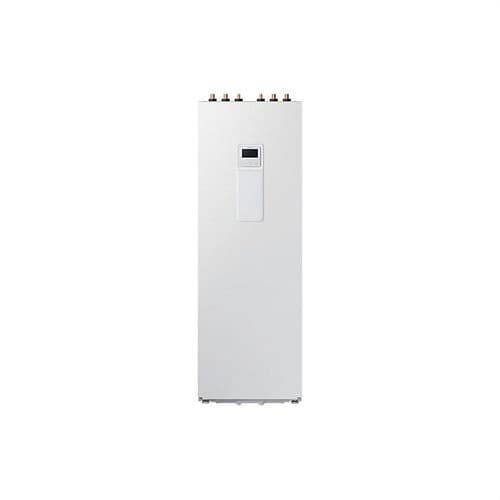
Information about Samsung ClimateHub Indoor Unit with Integrated 260 L Tank
The Samsung ClimateHub Split AE260RNWSEG/EU indoor unit is a hydraulic module for Samsung EHS air-to-water heat pump systems that integrates into a single unit the main components required for space heating, cooling, and domestic hot water production. It includes a 260-liter DHW tank, circulation pump, expansion vessel, heat exchanger, and backup electric heaters, offering a compact solution for residential heating, cooling, and hot water installations.
Its integrated design helps reduce the number of external components required and simplifies installation compared with solutions made up of a separate hydro kit and storage tank. With dimensions of 595 x 1,800 x 700 mm, the Samsung ClimateHub can be installed in technical rooms, utility rooms, and other indoor areas intended for HVAC equipment.
Integrated 260-liter DHW tank
The Samsung AE260RNWSEG/EU includes a domestic hot water tank with a nominal capacity of 260 liters and a usable volume of 254 liters. This capacity is designed for homes that require a high hot water reserve to cover the usual needs of showers, baths, and other draw-off points.
The storage tank is made of SUS 316L stainless steel, a material especially suitable for domestic hot water applications due to its corrosion resistance.
The tank supports a maximum water pressure of 10 bar and a maximum storage temperature of 70 °C. It also features polyurethane foam insulation to reduce heat losses and keep hot water for longer.
Fully integrated ClimateHub solution
One of the main advantages of the Samsung ClimateHub Split is the integration of different hydraulic components within a single unit. This reduces the number of separate elements that need to be installed in the technical room and makes system planning easier.
The unit integrates:
- DHW tank: 260 liters nominal capacity.
- Water circulation pump: BLDC Inverter technology.
- Expansion vessel: 8 liters internal volume.
- Heat exchanger: brazed plate heat exchanger.
- Backup heating element for heating: 2 kW.
- Immersion heater for DHW: 3 kW.
- Safety systems: valves, flow sensor, and thermal protections.
The integration of these components helps achieve a neater, more compact installation, while also reducing the external hydraulic interconnections required.
Domestic hot water production
The integrated tank is designed to meet the home’s domestic hot water needs. Samsung assigns this model an XL load profile and an A+ energy efficiency class for water heating.
The storage tank can reach a maximum water temperature of 70 °C and includes a 3 kW, 230 V immersion heater that provides support when system conditions require it.
The unit also includes a temperature and pressure safety valve for the tank, designed to protect the circuit against abnormal operating conditions.
Water heating and cooling
In addition to producing DHW, the Samsung ClimateHub indoor unit manages the hydraulic circuit used for home climate control. It can work with heat pump-compatible emission systems such as underfloor heating and cooling, fan coils, or low-temperature emitters, provided they have been correctly sized for the system’s operating temperatures.
Samsung specifies a water supply temperature range of 15 to 65 °C in heating and 5 to 25 °C in cooling.
Thanks to this wide temperature range, the system can adapt to different types of hydraulic installations, always within the conditions and configurations allowed by the associated Samsung EHS outdoor unit.
Integrated BLDC Inverter circulation pump
The AE260RNWSEG/EU includes a BLDC Inverter primary water pump, avoiding the need to add a separate main circulation pump in many configurations.
The pump can reach a maximum static pressure of 9.5 mH2O and works together with the system control to adapt water circulation to operating needs.
The unit also features a flow sensor with a detection range of 5 to 60 liters per minute, used to monitor correct hydraulic operation.
8-liter expansion vessel
A 8-liter expansion vessel with a specified operating pressure of 0.3 MPa is integrated within the ClimateHub itself.
This component absorbs water volume changes caused by temperature variations in the climate control circuit. The suitability of the integrated vessel for each installation should be checked during hydraulic sizing, especially in circuits with a large total water volume.
Plate heat exchanger
The unit uses a brazed plate heat exchanger to transfer heat between the refrigerant circuit and the hydraulic circuit.
This type of exchanger offers a large exchange surface in a compact format, helping reduce the space needed to integrate the hydraulic assembly within the ClimateHub itself.
Backup electric heating element for heating
The Samsung AE260RNWSEG/EU includes a 2 kW, 230 V backup electric heater. This element can complement heat pump operation when installation conditions or heating demand require it.
The heater includes thermal fuse protection and forms part of the safety and backup system of the hydraulic assembly.
Quiet operation
The ClimateHub indoor unit is designed to maintain low noise levels. Samsung specifies a sound pressure level of 26 dB(A) and a sound power level of 40 dB(A) for the indoor module.
These characteristics make it suitable for installation inside the home or in technical spaces close to living areas, always following the manufacturer’s installation recommendations.
Ready for photovoltaic and Smart Grid installations
The Samsung ClimateHub is ready for integration with photovoltaic and Smart Grid systems, allowing the air-to-water heat pump system to be incorporated into more advanced home energy installations.
This feature makes it easier to take advantage of energy management strategies when the rest of the installation’s components and controls are compatible and correctly configured.
Intuitive system control
The ClimateHub range supports Samsung controls designed to manage the system’s different functions. Using a compatible controller, it is possible to adjust parameters such as temperature, operating schedules, and heating, cooling, and DHW requirements.
The system also allows different setpoint temperatures for different hydraulic zones, a useful feature when a home combines, for example, low-temperature underfloor heating with other emitters that require different conditions.
Optional connectivity with Samsung SmartThings
Samsung offers the possibility of adding WiFi connectivity via a compatible kit purchased separately. With a properly configured installation, the system can be monitored and controlled remotely through the Samsung SmartThings app.
Available functions depend on the communication kit, the controller, and the specific installation setup. Remote access requires an Internet connection and a compatible Samsung account.
Hydraulic and refrigerant connections
The Samsung ClimateHub Split AE260RNWSEG/EU includes the necessary connections to integrate with the outdoor unit and with the hydraulic circuits for climate control and domestic hot water.
- Liquid refrigerant connection: 6.35 mm (1/4").
- Gas refrigerant connection: 15.88 mm (5/8").
- Climate control connections: 28 mm.
- Domestic hot water connections: 22 mm.
- DHW secondary return connection: 22 mm.
The refrigerant and hydraulic installation must be carried out according to the system sizing and in compliance with Samsung specifications for the selected outdoor unit.
Integrated safety systems
The unit incorporates different devices designed to protect the hydraulic circuit and the DHW tank.
- Circuit pressure relief valve: set to 2.9 bar.
- Flow sensor: range of 5 to 60 liters per minute.
- Tank temperature and pressure valve: 7 bar and 90 °C.
- Thermal protections: built into the electric heaters.
These elements are part of the equipment’s protection, although the complete installation must include all additional devices required by regulations and by the corresponding hydraulic project.
Technical specifications of the Samsung AE260RNWSEG/EU
- Brand: Samsung.
- Reference: AE260RNWSEG/EU.
- Range: EHS ClimateHub Split.
- Type: Split hydraulic unit with integrated DHW tank.
- Application: heating, cooling, and domestic hot water production.
- Indoor unit power supply: single-phase, 220-240 V, 50 Hz.
- Nominal tank capacity: 260 liters.
- Net tank volume: 254 liters.
- Tank material: SUS 316L stainless steel.
- Maximum tank pressure: 10 bar.
- Maximum tank water temperature: 70 °C.
- Tank insulation: polyurethane foam.
- DHW load profile: XL.
- Water heating energy class: A+.
- DHW immersion heater: 3 kW.
- Backup electric heater: 2 kW.
- Integrated expansion vessel: 8 liters.
- Circulation pump: BLDC Inverter.
- Maximum static pressure of the pump: 9.5 mH2O.
- Heat exchanger: brazed plate.
- Flow sensor range: 5-60 liters/minute.
- Heating supply temperature: 15-65 °C.
- Cooling supply temperature: 5-25 °C.
- Sound pressure: 26 dB(A).
- Sound power: 40 dB(A).
- Protection rating: IPX1.
- Net dimensions (width x height x depth): 595 x 1,800 x 700 mm.
- Net weight: 146 kg.
- Liquid refrigerant connection: 6.35 mm (1/4").
- Gas refrigerant connection: 15.88 mm (5/8").
- Hydraulic climate control connections: 28 mm.
- DHW connections: 22 mm.
- Ready for photovoltaic and Smart Grid: yes.
Compact design to simplify installation
Despite integrating a large-capacity tank and different hydraulic components, the ClimateHub maintains a vertical format of 595 mm width. This configuration makes it possible to concentrate a large part of the elements that would traditionally occupy different areas of the technical room into a relatively small footprint.
The all-in-one concept also makes it easier to access internal components during installation and maintenance tasks, helping to create a more organized technical room.
A complete solution for Samsung EHS air-to-water heat pump systems
The Samsung ClimateHub AE260RNWSEG/EU with integrated 260-liter tank is an indoor unit especially suitable for air-to-water heat pump installations where the goal is to combine hydraulic climate control management and a high domestic hot water storage capacity in a single unit.
Its stainless steel tank, Inverter circulation pump, expansion vessel, backup heaters, and plate heat exchanger help reduce the number of separate components in the installation, while its compatibility with Samsung control systems and Smart Grid readiness provide additional energy management options.
Important: this reference corresponds to the ClimateHub Split indoor unit. To have an operational air-to-water heat pump system, it must be combined with a compatible Samsung EHS Split outdoor unit, as well as the controls, hydraulic components, and accessories required according to the characteristics of each installation. The final power, efficiency, and operating range of the system will depend on the selected outdoor unit and the complete configuration.
